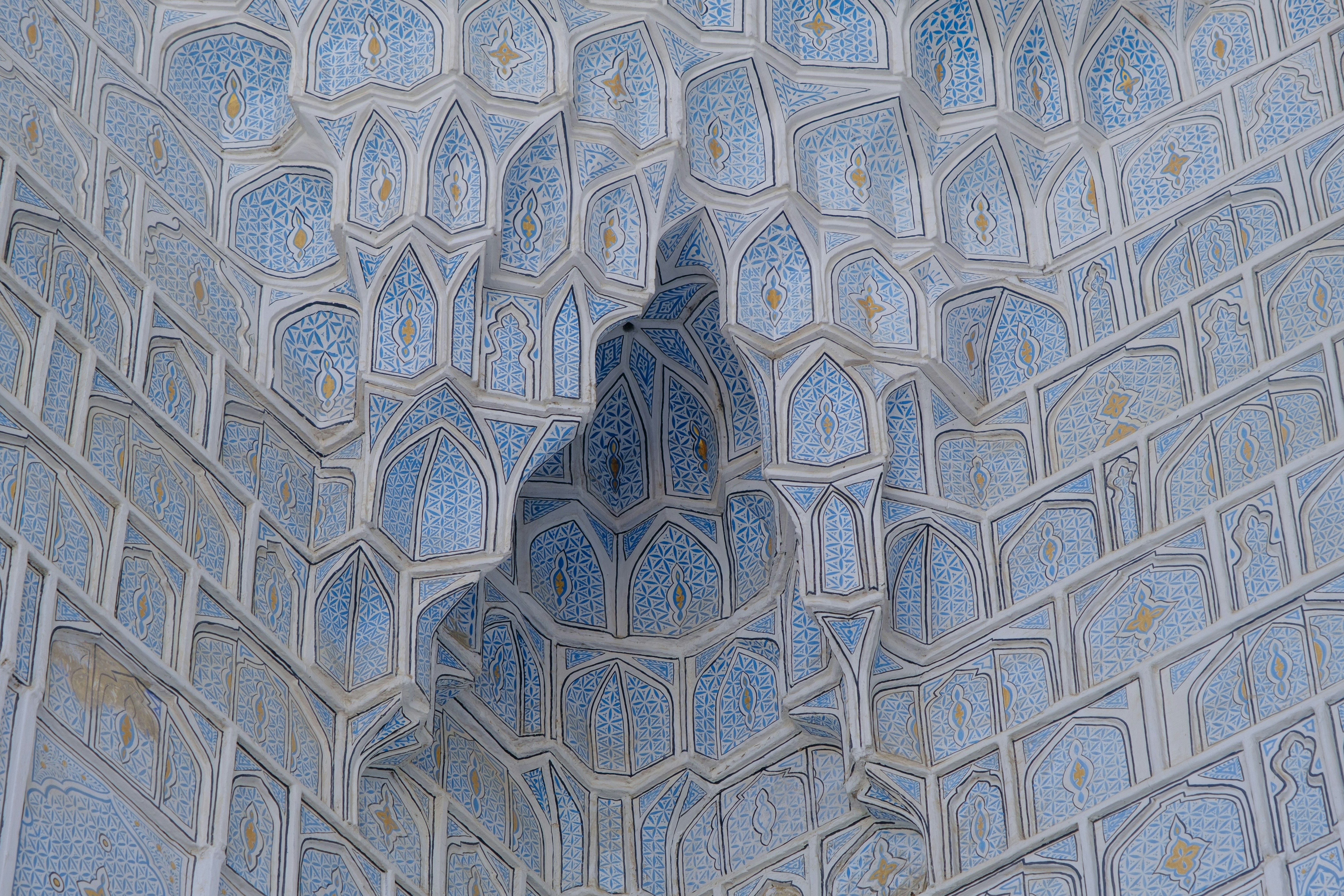
A crossroads of civilisations for seven millennia, Uzbekistan is today Central Asia's most populous and fastest-reforming economy — the source of SIRELIS's finest agricultural produce.
From the first Fergana Valley farmers to the Timurid Empire to the New Uzbekistan of today — a land that has always sat at the centre of the world.
The Fergana Valley has been farmed continuously for over seven thousand years. Samarkand — founded as Maracanda — was already a major urban centre when Alexander the Great arrived in 329 BCE. The Zerafshan River basin and Fergana Valley served as critical waypoints on the overland Silk Road, connecting the Han Dynasty China with Persia, Arabia, and Rome. Spices, silk, glassware, and knowledge moved along these routes for centuries.
Under Timur (Tamerlane) and his dynasty, Samarkand became the capital of an empire stretching from Anatolia to northern India. The Timurids were passionate patrons of art, science, mathematics, and astronomy. The Registan ensemble, Bibi-Khanym Mosque, and the Gur-e-Amir mausoleum — all UNESCO World Heritage sites today — still stand as testament to what historians consider one of the most refined civilisations in Islamic history. Uzbek lands fed this empire with grain, cotton, silk, and fruit.
The Soviet era transformed Uzbekistan into a mono-culture cotton republic. Vast irrigation networks were built, opening the Mirzachul (Hungry) Steppe and Karakalpakstan lowlands to agriculture. However, excessive irrigation caused the near-complete drying of the Aral Sea — once the world's fourth-largest lake — an ecological catastrophe still being addressed today.
Uzbekistan declared independence on 31 August 1991, becoming one of the five new Central Asian republics. Under President Islam Karimov, the country pursued a cautious path of state-directed reform, maintaining economic stability while gradually opening key sectors. Infrastructure was expanded, the cotton and gas industries consolidated, and the groundwork laid for a diversified export economy. These were formative decades — building institutions, national identity, and the human capital that would power the reforms to come.
Since President Shavkat Mirziyoyev took office in September 2016, Uzbekistan has embarked on the most ambitious economic and social reform programme in its post-Soviet history. Currency liberalisation, mass privatisation, foreign investment incentives, visa liberalisation for 90+ countries, abolition of forced labour in cotton harvests, and a sweeping digital government programme have transformed the country's trajectory. Annual GDP growth has averaged above 6% consistently, poverty has been cut nearly in half, and Uzbekistan is attracting serious international investment across energy, agriculture, and technology.
Eight years of structural reforms have produced measurable results across economic, social, and agricultural dimensions — placing Uzbekistan among the fastest-transforming economies in the world.
Unified exchange rate introduced in 2017 ended a decade of currency restrictions. Business registration now completed in one working day. Over 1,600 state-owned enterprises have been privatised. Unemployment stands at 4.9% (2025) and inflation at approximately 7%. Poverty has fallen sharply from 11% in 2023 to 5.8% in 2025.
Uzbekistan has established 21+ Special Economic Zones offering tax advantages and streamlined customs. In 2025, China led investment at $17.1B, followed by Russia ($4.8B), Turkey ($2.9B), Saudi Arabia ($2.8B), and Germany ($1.8B). Investment is distributed across energy (17%), agriculture (10%), mining and metallurgy (8%), and construction (8%).
The abolition of forced cotton labour quotas freed farmers to diversify into higher-value crops. Total trade turnover reached $81B+ in 2025, up 20.7% year-on-year, with exports at $33.8B and imports at $47.6B. Food products account for 8.7% of exports. Uzbekistan is now the world's 6th-largest cotton producer and a top-10 exporter of dried fruits and nuts.
Uzbekistan launched an ambitious e-government programme with over 3.7 million active users. Business licenses, export permits, and customs declarations are filed digitally. The Digital Uzbekistan 2030 strategy targets a $5B digital economy. Fibre-optic coverage reached 80%+ of regional centres by 2024.
Visa-free access extended to citizens of 90+ countries. Tourist arrivals grew from under 2 million (2016) to 6.7 million (2023). The UNESCO sites of Samarkand, Bukhara, Khiva, and Shahrisabz attract history travellers from around the world. Tourism revenue now a meaningful contributor to GDP.
Per-capita incomes have more than doubled since 2016 in dollar terms. Poverty fell from 17% in 2018 to 11% in 2023 and further to 5.8% in 2025 — one of the fastest reductions in the region. Unemployment stands at 4.9%. New schools and universities are being built across rural regions, and female workforce participation is steadily rising.
Uzbekistan's 14 regions. Hover to highlight.
Loading map data…